Building Our Lakehouse with Apache Iceberg
A modern lakehouse architecture using Apache Iceberg, Lakekeeper, Spark, Trino, and AWS.
Rigid schemas, expensive compute-storage coupling, and painful migrations eventually expose the limits of a traditional data warehouse. An Apache Iceberg lakehouse separates those concerns while preserving transactional guarantees.
Why a Lakehouse?
A lakehouse gives you the best of both worlds: the cheap, scalable storage of a data lake with the transactional guarantees and schema management of a warehouse. The key enabler is an open table format that sits between your storage and your query engines.
Three table formats were evaluated:
| Format | ACID | Time Travel | Schema Evolution | Community |
|---|---|---|---|---|
| Apache Iceberg | Yes | Yes | Full (add, drop, rename, reorder) | Very active |
| Delta Lake | Yes | Yes | Add/rename only | Databricks-centric |
| Apache Hudi | Yes | Limited | Add only | Uber-centric |
Iceberg won because of its complete schema evolution, hidden partitioning (no need to manage partition columns in queries), and its open REST catalog spec, which avoids vendor lock-in.
The Architecture
The resulting lakehouse stack looks like this:
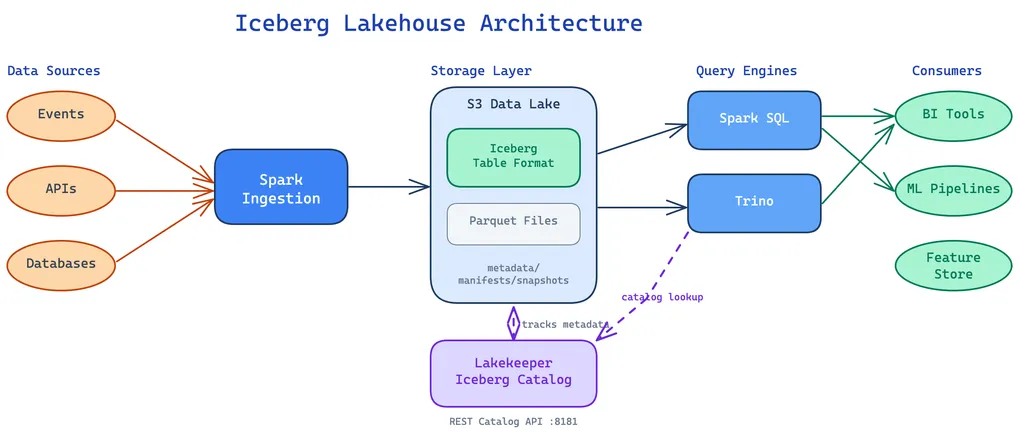
Storage: S3 + Iceberg
All data lives in S3 as Parquet files, organized by Iceberg’s metadata layer. Iceberg tracks every change as an immutable snapshot—a tree of manifest files pointing to data files. That enables:
- Time travel: Query any previous version of a table by snapshot ID or timestamp
- Atomic commits: Multi-file writes either fully succeed or fully roll back
- Partition evolution: Change partition schemes without rewriting data
-- Query a table as it was yesterdaySELECT * FROM eventsFOR SYSTEM_TIME AS OF TIMESTAMP '2026-03-14 00:00:00';
-- Roll back a bad writeCALL system.rollback_to_snapshot('events', 1234567890);
Catalog: Lakekeeper
The catalog is the brain of the lakehouse: it tracks which tables exist, where their metadata lives, and enforces access control. Lakekeeper is an open-source Iceberg REST catalog that implements the Iceberg REST Catalog Spec.
Lakekeeper provides:
- REST API on port 8181 — any Iceberg-compatible engine can connect
- Multi-engine support — Spark, Trino, Flink all talk to the same catalog
- Namespace management — organize tables into logical groups
- Access control — table-level permissions
# Configure Spark to use Lakekeeperspark.conf.set("spark.sql.catalog.lakehouse", "org.apache.iceberg.spark.SparkCatalog")spark.conf.set("spark.sql.catalog.lakehouse.type", "rest")spark.conf.set("spark.sql.catalog.lakehouse.uri", "http://lakekeeper:8181")spark.conf.set("spark.sql.catalog.lakehouse.warehouse", "s3://data-lake/warehouse")Query Engines: Spark SQL + Trino
Two query engines operate against the same Iceberg tables:
- Spark SQL for heavy analytical workloads, ML feature pipelines, and batch transforms
- Trino for interactive queries, dashboards, and ad-hoc exploration
Both engines read from the same S3 data through the same Lakekeeper catalog. There’s no data duplication — just different compute engines optimized for different access patterns.
Operational Findings
Hidden partitioning is a game changer
With Iceberg, you define partition transforms at the table level, and queries automatically benefit without users needing to filter on partition columns:
-- Iceberg partitions by day(event_time) automatically-- This query only scans the relevant day's filesSELECT * FROM events WHERE event_time > '2026-03-14';No more WHERE year=2026 AND month=3 AND day=14 in every query.
Incremental updates without full rewrites
Iceberg’s overwrite_partitions mode reprocesses only the partitions that changed, leaving everything else untouched. Combined with snapshot isolation, concurrent readers never see partial writes—they get either the old snapshot or the new one.
Transactional writes and upserts
Iceberg supports row-level operations like MERGE INTO, providing true upsert semantics on a data lake. New rows and updates land in one atomic operation—work that traditionally required a full table rewrite or a complex CDC pipeline over raw Parquet.
Write-Audit-Publish (WAP)
Write-Audit-Publish (WAP) is one of Iceberg’s most useful operational features. It starts with a single table property:
ALTER TABLE events SET TBLPROPERTIES ('write.wap.enabled' = 'true');Rather than writing directly to a table’s main branch, a pipeline writes to an isolated staging branch. Data quality checks run there, and the data is published to main only if they pass. A failed validation rolls the branch back, so readers on main never see bad data.
Table properties as a metadata contract
Iceberg table properties are also a useful metadata contract. Custom properties can tag tables with context that semantic layers, agents, and downstream consumers discover programmatically:
ALTER TABLE analytics.events SET TBLPROPERTIES ( 'platform.medallion.layer' = 'gold', 'platform.watermark.high' = '2026-03-18', 'platform.watermark.low' = '2026-01-01');The medallion layer property tells consumers whether they’re looking at raw, cleaned, or aggregated data. Watermarks advertise the freshness window — an AI agent or semantic layer can inspect these before deciding whether the table is suitable for a given query. Since properties are part of Iceberg metadata, they’re versioned alongside everything else and queryable through the REST catalog.
Schema evolution without downtime
Columns can be renamed, nullable fields added, and partition schemes changed without rewriting a single data file. Iceberg handles each through metadata-only operations.
Snapshot expiration matters
Iceberg keeps every snapshot by default. Without cleanup, metadata and orphaned data files grow forever. A scheduled Spark job expires snapshots older than 7 days and removes unreferenced data files:
CALL system.expire_snapshots('events', TIMESTAMP '2026-03-12 00:00:00');CALL system.remove_orphan_files('events');Dropped-table cleanup is also bounded: Lakekeeper automatically purges a dropped table’s data files from S3. A configurable soft-delete window allows restoration before an internal task queue removes the underlying files.
For new lakehouse architectures, Iceberg plus a REST catalog is a strong starting point. The open ecosystem avoids locking compute into one vendor.