From 60 Minutes to 4: Optimizing Spark MERGE INTO on a 2 Billion Row Iceberg Table
Optimizing a daily Iceberg upsert from an hour to under 4 minutes with storage partition joins and shuffle hash hints.
A daily pipeline upserts ~50 million records into an Iceberg table with over 2 billion rows, powered by the open-source Lakekeeper REST catalog. The table serves as a fresh source of truth for downstream systems.
The problem: MERGE INTO on a table this size took about an hour. Storage-aware joins brought it below 4 minutes.
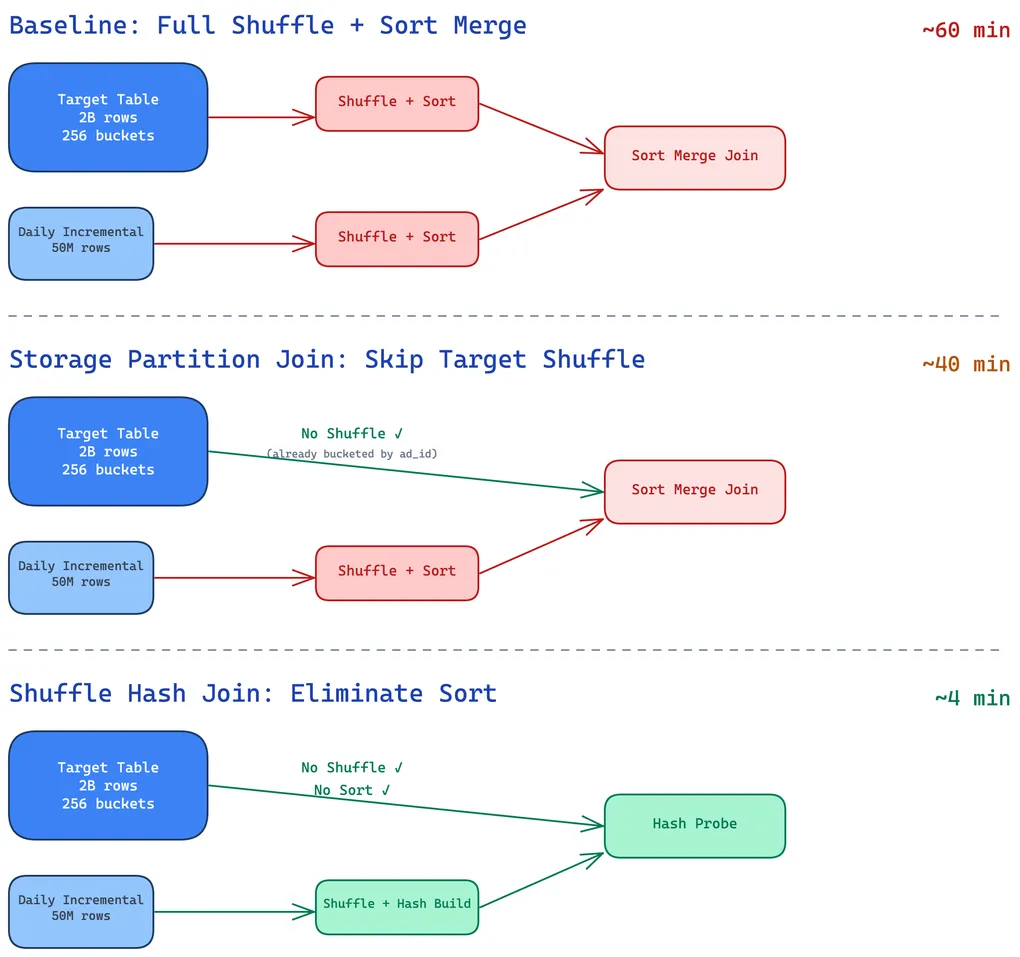
The Baseline: 60 Minutes
The naive approach is straightforward — merge the daily incremental data into the target table:
MERGE INTO analytics.events AS targetUSING daily_incremental AS sourceON target.entity_id = source.entity_idWHEN MATCHED THEN UPDATE SET ...WHEN NOT MATCHED THEN INSERT ...On a 2 billion row table with 50 million new records per day, Spark has to shuffle both sides on entity_id, sort them, and then execute the merge. That amount of network movement pushed runtime to about an hour.
Optimization 1: Storage Partition Join → 40 Minutes
The target table was already bucketed by entity_id into 256 buckets, physically organizing data on disk by the join key. Spark can take advantage of this with a storage partition join: instead of shuffling the massive target side, it reads each bucket directly. The key enabler is spark.sql.sources.v2.bucketing.shuffle.enabled, which tells Spark to shuffle the smaller side (50M rows) according to the partitioning reported by the larger side (256 buckets), so only the incremental data moves across the network.
# Enable storage-aware bucketing (Iceberg v2 tables)spark.sql.sources.v2.bucketing.enabled=truespark.sql.sources.v2.bucketing.pushPartValues.enabled=truespark.sql.sources.v2.bucketing.shuffle.enabled=trueThis alone dropped the runtime from 60 to ~40 minutes. The shuffle was no longer the bottleneck — but sorting still was.
Optimization 2: Shuffle Hash Join → 4 Minutes
Even with 256 buckets, Spark was still sorting both sides within each bucket before the merge. That’s sorting ~8 million rows per bucket on the target side, 256 times over. Sorting was the new bottleneck.
The fix: force a shuffle hash join on the smaller (incremental) side. A hash join builds a hash table from the smaller side and probes it with the larger side — no sorting required.
MERGE INTO analytics.events AS targetUSING /*+ SHUFFLE_HASH(source) */ daily_incremental AS sourceON target.entity_id = source.entity_idWHEN MATCHED THEN UPDATE SET ...WHEN NOT MATCHED THEN INSERT ...# Prefer hash join over sort mergespark.sql.join.preferSortMergeJoin=false
# Match shuffle partitions to bucket countspark.sql.shuffle.partitions=256This eliminated the sort on the 2 billion row side entirely. Runtime dropped to ~4 minutes.
The Gotcha: Spark Doesn’t Always Listen
The shuffle hash hint worked only sometimes. On other runs, the pipeline reverted to 40 minutes because Spark silently chose sort merge join instead.
Spark is the final arbiter of join strategy. Even with a hint, it does a safety check: will the smaller side’s partition fit in memory? If Spark estimates it won’t, it falls back to sort merge join. This estimation uses spark.sql.autoBroadcastJoinThreshold — not just for broadcast joins, but also as a heuristic for whether a shuffle hash join is safe.
Disabling Adaptive Query Execution (AQE) alone did not stop the plan from changing. The reliable fix required both settings:
# Disable AQE to prevent runtime re-optimizationspark.sql.adaptive.enabled=false
# Set threshold high enough so Spark trusts the hash join is safespark.sql.autoBroadcastJoinThreshold=512MB
The autoBroadcastJoinThreshold tells Spark: "a partition of the smaller table up to this size can fit in memory." Daily incremental data across 256 buckets worked out to ~200MB per partition, so a 512MB threshold gave Spark enough headroom to pick shuffle hash join consistently.
With both settings in place, the pipeline runs under 4 minutes every single time.
Summary
| Optimization | Runtime | What Changed |
|---|---|---|
| Baseline (full shuffle + sort merge) | ~60 min | — |
| Storage partition join (skip target shuffle) | ~40 min | Eliminated shuffle on 2B row side |
| Shuffle hash join hint | ~4 min | Eliminated sort on 2B row side |
| + Disable AQE + set autoBroadcastJoinThreshold | ~4 min (consistent) | Prevented Spark from falling back to sort merge |
The takeaway: on bucketed Iceberg tables, the combination of storage partition joins and shuffle hash hints can be transformative. But Spark’s join strategy selection has subtle heuristics — you need to understand what’s happening under the hood to make it stick.